How to get your startup recommended when someone asks AI for a tool
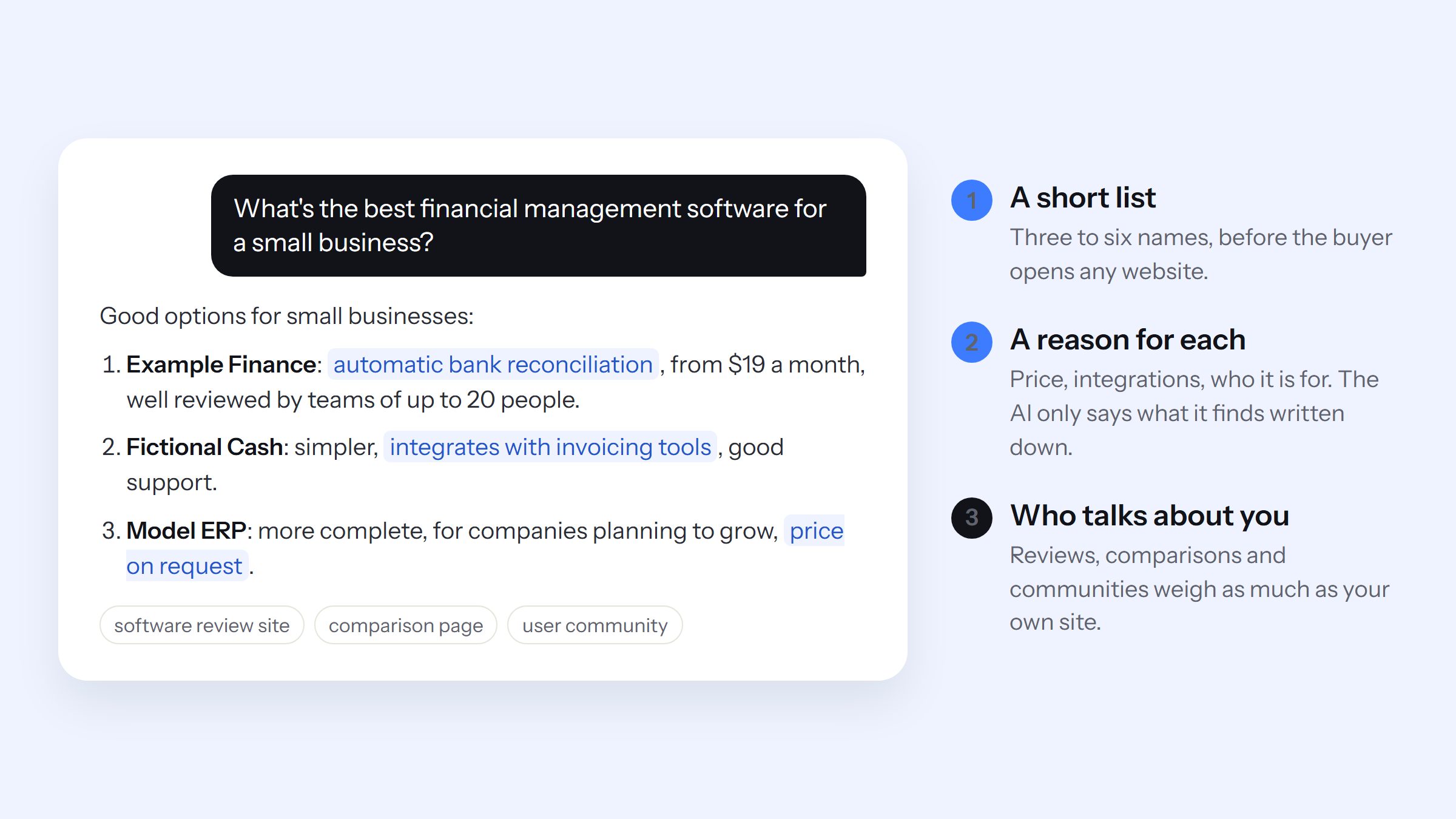
“What’s the best financial management software for a small business?” “What are the alternatives to [the tool I use today]?” More and more, choosing software starts like this, in a conversation with ChatGPT, Gemini or Google, not in a search with ten links. The answer brings three to six names, a sentence about each one and, sometimes, where the AI got that from.
For a startup, this changes the game in a specific way: the shortlist is formed before the buyer reaches your website. If your company isn’t on it, you don’t lose the deal at the demo. You lose it earlier, without knowing.
What’s different from a local business
A clinic competes for a recommendation in its neighborhood, and the map and Google profile carry a lot of weight. A tech company competes for something else:
- There’s no map. The whole competition happens in the text of the answer.
- The questions are about category, comparison and price: “best [category] for [type of company]”, “alternatives to [competitor]”, “[you] or [competitor]?”, “how much does a [category] cost?”, “[category] with good support”.
- The AI leans on who talks about you, not only on what you say about yourself. Software review sites, comparison pages, user discussions in communities, your documentation and industry press.
This guide comes from pleeku’s software checklist, built from public studies on the sources AIs cite. Our own numbers will come with our first software measurements, and we’ll update this post with them.
What to do, in order
1. A homepage that says what the product does and who it’s for
If your homepage opens with “the platform that transforms the way companies work”, the AI has no way to connect your brand to “what’s the best financial management software for small businesses?”. State the category in your customer’s words, who it’s for and what it solves, right at the top. The same goes for the page title and the description that shows up in search.
2. Complete profiles on software review sites, with recent reviews
When the question is “what’s the best…”, AIs look at review sites to learn who exists, who each tool is for and what customers say. Claim your company’s profile on the review sites for your category and market, fill in the description, category, integrations and pricing, and ask real customers for reviews, continuously. A review that says “we replaced the spreadsheet and now close the month in two days” is worth far more than “great product”.
3. Honest comparison and alternatives pages
“Alternatives to X” and “X or Y” are among the most common software questions, and AIs cite the pages that answer exactly that. Have a page for each relevant comparison, with what each tool does best, who each one is for and what each costs. Be fair: comparisons that disparage a competitor or distort facts are prohibited by advertising rules (the FTC in the US; CONAR and the Consumer Protection Code in Brazil) and lose credibility with readers anyway.
4. Public pricing, or at least a range
“How much does a … tool cost?” only cites whoever shows a price. If yours is “contact us”, the AI answers with what other sites say about you, which may be wrong or outdated. A range (“from $X per user”) is enough.
5. Open documentation and help center
“Does [your tool] integrate with [another]?” is answered from your documentation, if it’s public. Documentation behind a login is invisible to the AI. One page per integration, with what you can and can’t do, answers exactly that question.
6. Real presence in your industry’s communities
AIs use user discussions to say what people think of each tool. Take part with the company’s or the founder’s account, answering questions and owning criticism. Never create fake accounts to praise your own product: besides being unethical, communities find out and it backfires.
7. Mentions in the press and industry sites
An article, a podcast or a case study on an industry site gives the AI a second, independent source saying what your company does. The more sources agree, the easier it is for the AI to put you on the list.
8. The basics that reinforce the rest
- An up-to-date company page on LinkedIn: in B2B questions, it helps the AI confirm what the company does and its size.
- Demos on YouTube: they answer “how does it work” and show up in Google’s answers.
- Organization and software structured data on your site: it tells machines, without ambiguity, who the company is and what the product does.
- Wikipedia, only if the company is genuinely notable. A page created by the company itself without independent sources gets deleted.
How to test it in 15 minutes
- Write five questions the way your buyer would: your category for their type of company, “alternatives to [the competitor they use today]”, “[you] or [competitor]?”, pricing and support.
- Ask each one on ChatGPT, Gemini and Google (with AI Mode), on two different days.
- Write down: did you show up? In what position? Who showed up instead of you, and with what sentence? Which sites did the AI cite?
- Open the cited sites. If the answer cites a review site, a comparison or a discussion you’re not part of, that’s your next step.
What not to do
- Buy reviews or trade reviews for discounts. Review sites take them down, and advertising rules prohibit them.
- Promise results. “We guarantee 3x more sales” doesn’t convince the AI or the buyer, and it exposes the company.
- Write for the machine. A page stuffed with “best management software” won’t help. Write for the buyer who is going to read it.
Nobody controls what AI answers, and anyone promising the top spot is selling something they don’t have. What you can do is be on the sources it reads, with the right information, and measure regularly whether your company is making the shortlist.
pleeku tracks this for tech companies too: category, comparison and brand questions across four AIs, who shows up instead of you, the sites cited and what to fix first.