How to get your clinic recommended when someone asks ChatGPT
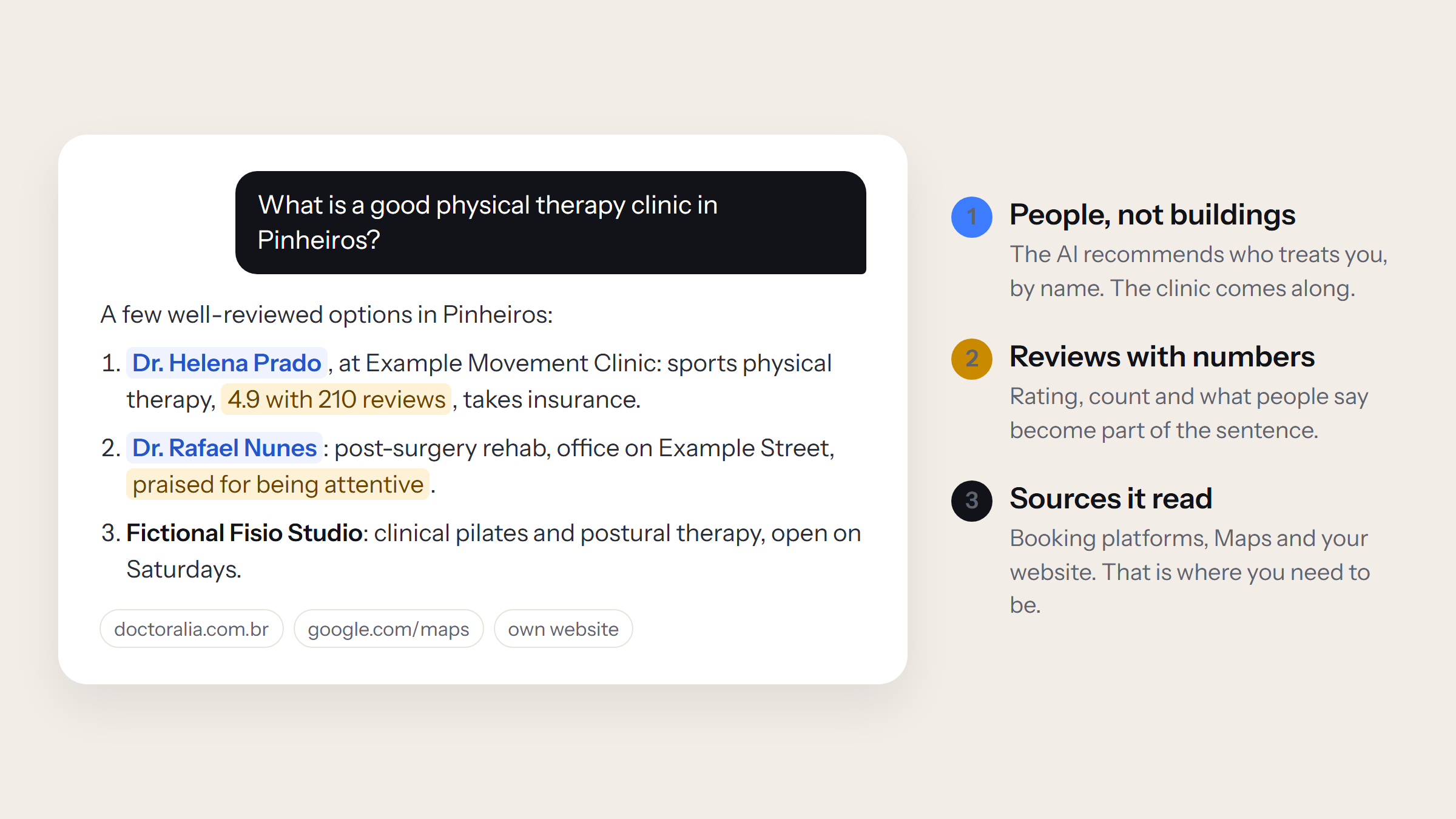
“What’s a good physical therapy clinic in Pinheiros?” Whoever asks ChatGPT, Gemini or Google that question doesn’t get ten blue links. They get three to five names, a sentence about each one and, sometimes, where the AI got that from. If your clinic isn’t in that sentence, as far as that person is concerned, it doesn’t exist.
The good news is that the AI doesn’t make the list up out of thin air. It builds the answer from what it finds online about you and everyone else. You can see what it reads and work on that.
What we saw in 95 answers
We asked the same healthcare questions (“who is the best plastic surgeon in Barra?”, “nutritionist in Botafogo”, “dental clinic in Pinheiros”) to ChatGPT, Gemini, Google’s AI Mode and AI Overviews, several times each, and read all 95 answers one by one. It’s a small sample, healthcare only, in two Brazilian cities, but a few patterns were clear:
- AI recommends people, not buildings. The most cited names were practitioners, with “Dr.” in front, not clinics. When a clinic did show up, it almost always came attached to the name of someone who works there.
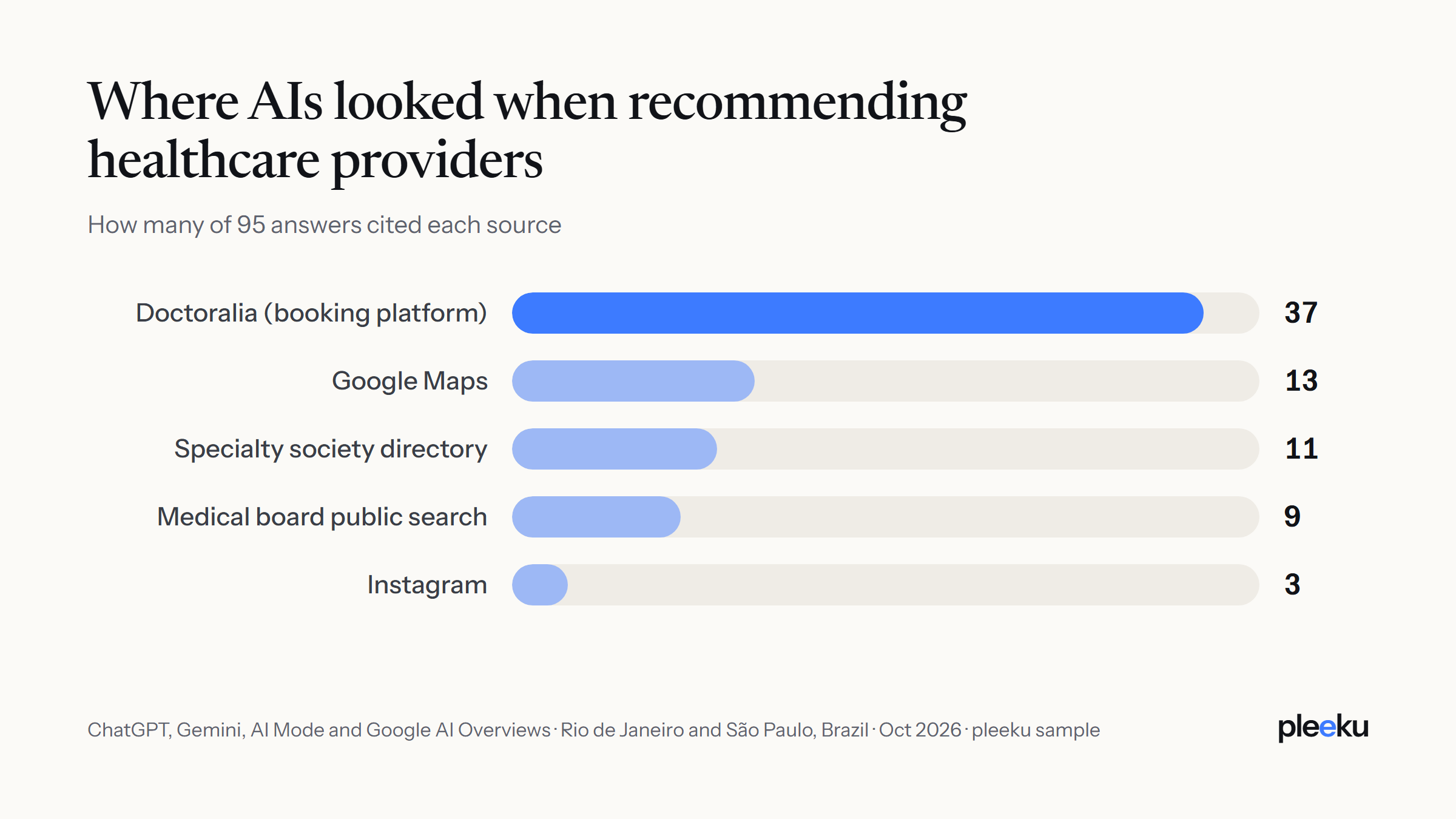
- Healthcare platforms carry a lot of weight. Doctoralia, the largest booking platform in Brazil, was cited in 37 of the 95 answers, across all four AIs. It was the most cited source of all.
- Google Maps comes in through the front door. Maps links showed up in 13 answers, and AI Mode and AI Overviews build their local recommendations from Google business profiles.
- Licenses and societies add credibility. The specialty society’s directory was cited in 11 answers, and the professional board’s public license search in 9, with the AI repeating the license number.
- Reviews are the favorite topic. In what the AI says about each name, reviews come up more than anything else, often with the count (“4.9 with over 300 reviews”).
What to do, in order
1. One page per practitioner on your website
If AI recommends people, every practitioner at your clinic needs their own page: full name, specialty, license number, what they treat, at which location and on which days. A “Meet the team” page with photos and first names doesn’t cut it: the AI can’t connect “Dr. Ana” to a license, a specialty and an address.
2. One complete Google profile per location
Each address is a separate place on Maps. For each location: the right category, services listed one by one, hours (including holidays), phone, website, real photos and the insurance plans you accept. “Who takes plan X in Moema?” is a common question, and the AI can only answer with what’s written down.
3. Complete profiles on the healthcare platforms in your market
Doctoralia in Brazil, and the booking and review platforms in your own field and country, are where the AI looks for information the most. Fill in every practitioner’s profile with the same specialty, procedures, address and insurance plans as your site and your Google profile.
4. A visible license and a spot in your specialty society’s directory
Check that each practitioner’s name and license number show up correctly in the professional board’s public search, and that they’re listed in their specialty society’s directory. The AI treats these as trustworthy sources, and showing the license is mandatory in your communication anyway.
5. Recent reviews that mention the procedure and the neighborhood
“I had my root canal with Dr. Ana at the Paulista location” tells the AI much more than “great service”. Reply to reviews, taking care not to expose any patient information. Before asking for reviews, check your professional board’s rules on testimonials: they vary from one profession, and one country, to another.
6. One page per procedure, with the neighborhood
People ask about a procedure in a place: “dental implants in Tijuca”, “lymphatic drainage in Moema”. A page that explains the procedure, who does it and at which location answers exactly that question.
7. The same name, address and phone everywhere
In the answers we read, the same practitioner was spelled differently by different AIs. Use the same spelling of the name, the same address and the same phone number on your site, on Google, on the platforms and on social media.
How to test it in 15 minutes
- Write five questions the way a patient would, with the service and the neighborhood. Mix choice (“what’s the best…”), recommendation (“who do you recommend…”) and doubt (“how do I choose a good…”).
- Ask each one on ChatGPT, Gemini and Google (with AI Mode), on two different days. The answer changes from one time to the next.
- Write down: did you show up? In what position? Who showed up instead of you? Which sites did the AI cite?
- Open the cited sites and check whether you’re on them, with the right details.
Whatever keeps repeating in your notes is your to-do list.
What not to do
- Buy reviews or ask for them in exchange for a discount. Besides being prohibited, platforms take them down.
- Promise results. “Guaranteed results” is banned by every professional health board we checked, and before-and-after photos and discount pricing are banned or restricted by most. None of it helps the AI recommend you.
- Write for the machine. A page stuffed with “best clinic in Pinheiros” won’t convince the AI or the patient. Write for whoever is going to read it.
Nobody controls what AI answers, and anyone who says they can guarantee you’ll show up is selling something they don’t have. What you can do is be in the places it reads, with the right details, and measure regularly whether that’s changing the answer.